With school coming to an end for another year, April serves as the start of more free time to relax and do things that were pushed aside during the school year like video games. While I did get some time playing games between studying and working, it seems like the floodgates have just opened in these last couple of weeks. Funny enough, the end of the school year coincided with finally completing Bravely Default after spending the last two and a half months working on beating the game. Spending so much time with one game felt very limiting that now this feeling of freedom and choice is almost overwhelming. The spring and summer months should be fun as I will be bouncing between games from my ever-growing backlog and brand new releases. It should be a fun journey that will be chronicled right here on Silver Bit. So stay tuned.
Game of the Month
Ever since I beat Bravely Default, I have been able to spend more time playing a wide variety of games. In the few weeks since I beat Bravely Default, I have been playing Golden Sun, Resident Evil 6 and Donkey Kong Country: Tropical Freeze and have completed shorter games like Rhythm Thief, SteamWorld Dig and Donkey Kong 1994. As great of an achievement beating a long, gruelling RPG is, playing a game for over 100 hours can be exhausting. The change of pace has been refreshing especially with one game in particular pulling me in more and more. That game is Infamous: Second Son and it is the one game that has got me to play the PS4 on a rather consistent basis. I have dabbled with the previous entries in Sucker Punch's superhero playground, but never for any considerable amount of time. Compared to other open world sandboxes, Second Son's setting of Seattle may seem a little lifeless, bland and full of hilarious glitches. Even with those drawbacks, I have had lots of fun just running around, completing side missions, collecting blast shards and beating up waves of DUP officers and drug dealers. The most fun to be had with Second Son comes from the new powers you get to play around with. While the smoke and video powers are cool, the best power in the game is neon. Zipping around Seattle at supersonic speeds, slowing down time to aim and sniping enemies with precise neon shots make for a power players will stick to throughout their entire playthrough. Infamous: Second Son may not be the best open-world superhero game as Batman still holds that honour in my opinion, but it is definitely the best game on PS4 right now. Second Son deserves to be in every PS4 owner's library.
Most Anticipated Game of the Month
Super Smash Bros. for Wii U and 3DS are easily the two most anticipated games of 2014. A new entry in the Smash Bros. series only happens every four years or more so any news or announcement about the newest entry is an event in itself. Aside from Masahiro Sakurai's daily screenshots on Miiverse, there has not been a major dump of information about Super Smash Bros. since E3 2013. Early this April, Nintendo and Sakurai took some time away from developing Super Smash Bros. to deliver a Nintendo Direct focused solely on the two games. During the nearly 40 minute presentation, Sakurai touched on the release dates, included stages, online play, differences between the two versions, items, assist trophies and returning and new inclusions to the roster among a plethora of additional information. It is impossible to capture the greatness of this Nintendo Direct in mere words. It is incredibly produced, filled with tons of goodies that will make any gamer smile ear to ear and easily sold hundreds to buy a Wii U, 3DS or possibly both. Personally, my excitement for Super Smash Bros. is at unimaginable levels. Even thinking about the games makes me giddy with excitement. Summer and Winter 2014 cannot come any sooner.
Video of the Month
Usually I never have a problem picking the Video of the Month, but this April has been the exception. There has been so many great videos this month from the wacky Tomodachi Life Direct to Screwattack's epic interviews with the creator of Videoball Tim Rogers to Mega64's collaboration with Nintendo on the recent Nintendo E3 announcements. While they are all incredible videos and deserve to your viewing, I have to give the Video of the Month to a video that got me thinking. The Completionist's Final Fantasy VII Retrospective has been a month-long event where Jirard and a crew of Youtubers take an in-depth look at the impact that Final Fantasy VII has had on RPGs and video games in general. This in-depth analysis of Final Fantasy VII really made me see the game in a new light and truly understand why people hold the game on such a high pedestal. While the first two videos were released in March, the majority of this series has come out throughout April and deserves the recognition for how great it is. I will share the first part here, but I highly recommend watching this series in its entirety. It will give you a new appreciation of Final Fantasy VII as it has done for me.

Wednesday, April 30, 2014

Monday, April 28, 2014
Top 5 Game Boy Advance Games

The Game Boy Advance put the power of the Super Nintendo, arguably one of the greatest video game consoles ever created, in the palm of your hands. Although small in size, Game Boy Advance cartridges housed some of the best experiences from that beloved era of gaming such as A Link to the Past, Super Mario World, Donkey Kong Country and Final Fantasy VI along with brand new classics like Advance Wars, Golden Sun and Drill Dozer. The Game Boy Advance was the one video game system that introduced this writer to likes of Castlevania, Metroid and Fire Emblem, easily some of my favourite video game franchises. In honour of the Game Boy's silver anniversary and the launch of the Game Boy Advance Virtual Console on Wii U, I would like to share my Top 5 Game Boy Advance games. For this Top 5, I will be excluding any Super Nintendo port because they can overshadow the original titles released for the Game Boy Advance which deserve the recognition. Enjoy the Top 5 and hopefully Nintendo will bring some of these titles to the Virtual Console for all to enjoy.

Over the years, Capcom has developed various different iterations of the Blue Bomber from a robot-hunting mercenary to a living computer AI. Each iteration focuses on a different aspect of game design such as the infusion of an overarching story in the X series to the RPG elements of the Battle Network series. The best iteration of Mega Man in this writer's opinion is Mega Man Zero for the Game Boy Advance. Introduced as a character in the X series, Zero finally got the top billing that he was originally meant to receive in Mega Man X with Mega Man Zero. 100 years after the events of Mega Man X, Zero is awakened to help the Reploid resistance in their fight against his former friend X and the Neo Arcadian army. While the story of Mega Man Zero spans four games, it is the first game that set the gold standard for the series with excellent action-platforming, fast-paced combat, challenging yet rewarding difficulty and heart-pumping music. For those who missed out on Mega Man Zero on Game Boy Advance, the Mega Man Zero Collection for the Nintendo DS is a perfect way to experience this series in its entirety.

No one ever though Mario and RPG mechanics would ever be a good combination. In actuality, Nintendo's iconic plumber is more than well-suited for the RPG genre as proven by both Super Mario RPG and Paper Mario. Inspired by Mario's previous ventures into RPGs, Mario & Luigi: Superstar Saga took Mario RPGs in a different direction by limiting your party to just two characters-- Mario and Luigi. The battles were ultimately turn-based, but involve much more input than your regular RPG. Mario and Luigi always need to be on their toes at all times as they can cause more damage or even outright avoid attacks with a perfectly timed button press. Exploring the overworld in Superstar Saga was not limited by gravity as Mario and Luigi could platform their way through areas to further the story and find hidden items. The Mario Bros. repertoire of special moves and items like hammers and propeller jump allowed them to solve puzzles interspersed throughout the game. Along with the gameplay, the love for Superstar Saga comes from its signature humour which ranges from Luigi dressing up as Princess Peach to allude the main villains to all the hilarious results of missing button presses to initiate Bros. Attacks. While the series has only got better with each entry, Superstar Saga still stands as one of the best RPGs on the Game Boy Advance.

Before the Game Boy Advance, portable Castlevania games were among the worst entries in the series. With the power of the Game Boy Advance and later the Nintendo DS, Konami reversed the stigma firmly placed on portable Castlevanias for the better. Their quality easily outclassed every console Castlevania following Symphony of the Night. In fact, each portable entry has added their own additions to the Metroidvania formula introduced in Symphony of the Night such as Circle of the Moon's Dual Set-up System or the two interchangeable versions of Dracula's Castle in Harmony of Dissonance. Among the three Castlevania games on the Game Boy Advance, Aria of Sorrow is the best. Set in 2035, you play as Soma Cruz, the reincarnation of Dracula, as he stumbles upon Dracula's Castle hidden within a solar eclipse. Trapped in Dracula's Castle, Soma must use his abilities as Dracula's vessel to escape before transforming into the iconic vampire. Aria of Sorrow refines the same action-platforming and RPG mechanics used in the other Castlevania games for the Game Boy Advance to perfection. What differentiates Aria of Sorrow from other entires in the series is the Tactical Soul system. Instead of interchanging a select number of sub-weapons, Soma is able to absorb the souls of fallen enemies to acquire new attacks, summonable familiars, stat boosts and abilities which open up new areas to explore. Equipping different combinations of souls allows you to create your own unique Soma with the attacks and abilities you want to use. With the poor direction Castlevania has taken in recent years, Aria of Sorrow is a shining example of how great this franchise can be.

Fire Emblem is a series with a long and storied history. Sadly that long and storied history was exclusive to Japan until 2003. The first Fire Emblem to reach North American shores is one of the best tactical strategy games on any game system. Following the adventures of Eliwood, Hector and Lynn, three lords from the continent of Elibe, Fire Emblem tasks players with taking an army of allies to stop the evil forces of the Black Fang and their pursuit to unleash the powers of the Dragon Gate on the world. Fire Emblem's greatest strength came from the gameplay which has one managing the strengths and weaknesses of weapons and magic, the durability of items, character stats and the range of allies and enemies to overcome insurmountable odds. At the game's best, it feels like playing a game of chess with medieval knights and wizards as your chess pieces. Along with introducing North American audiences to the core mechanics of the series, Fire Emblem introduced players to its most signature feature-- the permanent death of ally units. This feature caused plenty of chapter restarts from yours truly, but it made you feel connected to your units in a way no other tactical strategy game has done before. No longer were these units expendable pawns; they were living, breathing characters that you cared for and grew attached to over the course of the game. Their loss packed much more weight than losing a unit in a game like Advance Wars or Starcraft. This emotional weight along with excellent game mechanics made Fire Emblem a defining experience for the strategy genre in general.

Out of all the experiences available on the Game Boy Advance, one stands taller than the rest. This experience comes from gaming's favourite bounty hunter, Samus Aran. Actually, it is the remake of her first adventure to Planet Zebes in the original Metroid. Metroid may be an iconic achievement in video game design and development, but certain aspects of the game, namely the graphics and the unguided structure of the game, have not stood the test of time. Zero Mission took the original Metroid and upgraded the gameplay, graphics, level design, music and story to the masterful quality of Super Metroid. Zero Mission made Metroid better in every conceivable way and that was not the only thing it did. Zero Mission expanded on the original story of Metroid. No longer was defeating Mother Brain the final thing Samus did on Planet Zebes. In trying to leave Zebes, Samus is shot down by Space Pirates and stripped down to her Zero Suit. With no power to fight regular enemies, the game changes from your standard 2D action-platformer to a compelling 2D stealth game as Samus tracks down a brand new Power Suit in order to finally escape the clutches of Zebes. This incredible twist gave the final act of Metroid a greater sense of danger and vulnerability than fighting off countless waves of metroids. Hands down, Metroid: Zero Mission is the definitive version of a classic which preserves it against the negative effects of Father Time.
Monday, April 14, 2014
Bravely Default Review

Bravely Default's premise is very similar to first few Final Fantasies. You control the four Heroes of Light (Tiz, Agnes, Ringabell and Edea) as they purify four elemental crystals in order to save the world. On their journey to purify the crystals, the Heroes of Light must combat the forces of the Duchy of Eternia and discover the truth behind the Crystal Orthodoxy. On the surface, the story and the protagonists seem to fall under many classic JRPG tropes such as a heroes' hometown getting decimated and one of the heroes conveniently suffering from amnesia. As the story advances, the depth and complexity of the huge cast of characters becomes evident. The conflict between the Crystalism and Anti-Crystalism is not as black-and-white as the game originally makes it out to be. Bravely Default offers a good amount of twists and turns to keep gamers interested. While the story provides motivation to keep playing, it is not the most compelling feature of Bravely Default.
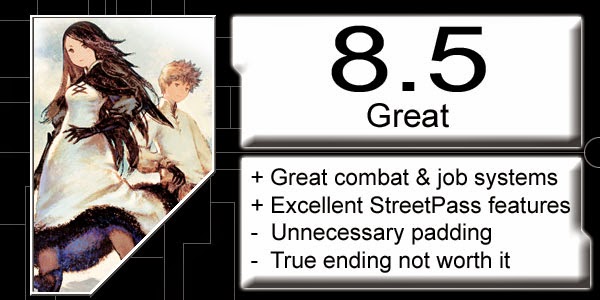
Bravely Default truly shines above other entries in the JRPG genre through its combat and job systems. The combat is similar to other turn-based RPGs as the player and their opponents takes turns attacking, defending and using items. The creative twist in Bravely Default's combat comes from the brave-default system. Default acts like defending as it decreases damage taken, but also increases battle points (BP). You use BP to brave, which allows a character to unleash multiple attacks in a single turn or spend on job-specific attacks and abilities. Braving and defaulting is a risk-reward system that adds an extra layer of strategy to battles. You can try to dispatch enemies in one turn by attacking multiple times, but you risk leaving your party vulnerable to multiple attacks if they survive your onslaught. Managing when to brave or default can be the difference between life or death in Bravely Default. The game's job system has clearly been inspired by the systems implemented in past Final Fantasy games. Although the inspirations from other titles, Bravely Default's job system is much more approachable than other RPGs due to the improvements Square Enix and Silicon Studio has made. Jobs level up independently of the character's actual level so changing jobs does not reset a character's overall level. While characters can only be employed by one job at a time, you can equip the attacks and abilities from another job to use as well. This feature allows for tons of customization as you can have a white mage that can cast black magic on top of healing spells or a knight that can imbue their blade with a spell fencer's sword magic. Going along with the customizable jobs, you can equip any special attribute learned through levelling up jobs or those your friends have learned through the Ablink feature. These two systems are only just one slice of the great suite of features that Bravely Default gives you to play with. From the excellent StreetPass and online features like rebuilding the town of Norende with the people you StreetPass and connect with online or summoning friends to help in battle to the incredible ability to change encounter rates and game difficulty at anytime, Bravely Default offers tons of features to keep players satisfied.
With all the great features and systems Bravely Default has to offer, it has one critical blemish that almost derails the entire experience. What easily could have been an excellent fifty to sixty hour experience receives some completely unnecessary padding that doubles the length of the game. What makes this padding even worse is how tedious it is. Instead of adding some worthwhile quests to elaborate on the story, you repeat the same exact tasks over and over again until the game deems it time to move on to the true final chapter. After the second time repeating this process, the story stops advancing altogether until the true final chapter which makes a good twenty hours of the game feel like an absolute waste of time. You can break from the tedium at anytime to complete the normal ending of Bravely Default, but that does not give much closure to the story of the game. Funny enough, the normal ending of Bravely Default is more satisfying than the true ending of the game because it lacks the drastic difficulty spike the true ending has and it makes more sense than most of the plot points inserted into the true ending with little to no explanation whatsoever. The true ending is not worth the time and effort needed to reach it. In fact, trying to reach the true ending could compromise your enjoyment of Bravely Default as a whole.
Aside from the unnecessary padding, Bravely Default is a great game. There are enough great features packed into this small 3DS cartridge to keep anyone satisfied for days, possibly months on end. The one thing holding Bravely Default back from being the definitive RPG experience on the 3DS is the major misstep taken in the most crucial hours of the game. Padding the game by a few hours is understandable, but by close to fifty plus hours cannot be easily reconciled. While the padding may leave some upset and disappointed, Bravely Default's strengths more than make up for the underwhelming endgame. For those looking for an old-school RPG with some excellent modern twists, Bravely Default is definitely a game worth picking up.
Monday, March 31, 2014
Bit by Bit: March 2014
March has always been a hectic month in terms of both gaming and schooling. March is the month that game publishers love dumping all the games that were not ready for the holiday. It is also the month, universities love dumping projects, tests and presentations on students as the semester comes to an end. Much of this month has been spent studying for a test or working on a project in between classes and shifts at work for yours truly. Even with all the craziness, I have luckily made time to relax by playing a game or watching some television. Although, relaxation was sometimes mixed with school work as I would do my anthropology readings during commercial breaks. While March is almost over, April will be just as crazy for this writer as things ramp up for final exams. Before we move on to the next month, let us look back at the month that was March 2014.
TV Show of the Month
Well, I spent the majority of my game time playing Bravely Default this past month. As it took up the majority of my time, it is easily my Game of the Month yet again. Instead of repeating myself by talking about Bravely Default (I will save it for the review hopefully), I wanted to share another facet of my passions this month--television shows. As I have grown older, my time watching television has cut down to just the shows I want to watch such as Agents of S.H.I.E.L.D., Persons of Interest and Reviews on the Run. I barely spend time endlessly surfing through channels anymore. As I gravitate to the shows that interest me the most, there a few I do not get to watch when they first run or they never make it to television in the first place. One of those shows is Fullmetal Alchemist: Brotherhood. Fullmetal Alchemist: Brotherhood is an anime which adapts the story of the original Fullmetal Alchemist manga into glorious 2D animation. Brotherhood follows Edward and Alphonse Elric on their quest to acquire the legendary Philosopher's Stone in order to restore the bodies they lost when trying to resurrect their deceased mother. Ed and Al's journey is not an easy one as they get caught up in a conspiracy that engulfs the entire country of Amestris. I watched the first half of Brotherhood years ago when Funimation started releasing them as 13-episode DVD sets, but never got the second half of the series because how expensive each set was. Then I got the second season of the 2003 Fullmetal Alchemist series for Christmas. After watching that series over again, I got this huge urge to finish Brotherhood. When I found the Complete Collection Two for 30 dollars at The Beat Goes On, I did not hesitate to buy it. A week and a half later, I watched all the 31-episodes included in the set and it was well worth it. While I already knew the entire story of Fullmetal Alchemist from reading the manga, watching the same story play out in motion was just unbelievable. The mix of excellent voice acting, superb music composition and incredibly beautiful animation just made everything feel brand new. The devilish twists and turns of Fullmetal Alchemist's endgame were perfectly adapted for the animation. There were moments in the anime that just work better in motion than in the panels of the manga. I was literally blown away by Fullmetal Alchemist: Brotherhood. While I do not watch many animes, Fullmetal Alchemist: Brotherhood is among the best I have ever seen and I highly recommend watching it.
Most Anticipated Game of the Month
I have shared my love for Mega Man here on Silver Bit on multiple occasions. Among the many Mega Man series Capcom has created over the years, the Mega Man Zero games are some of my favourites. Considering Capcom would rather keep the Mega Man franchise dormant than develop new titles starring the Blue Bomber, Mega Man fans have had to look elsewhere. In particular, they have gone to the Father of Mega Man, Keiji Inafune himself, to get their fix with Mighty No. 9, but it is not the only Mega Man-like title Inafune has in the works. Announced at the beginning of March, Azure Striker Gunvolt is a new 2D action-platformer from Comcept and Inti Creates coming to the 3DS Nintendo eShop this summer. Azure Striker Gunvolt looks very similar to the fast-paced action of Mega Man Zero just with a brand new character to control, psychic powers to acquire and crazy bosses to battle. As somebody who has fond memories of the Mega Man Zero series, I am really looking forward to what Comcept and Inti Creates has in store for Azure Striker Gunvolt.
Video of the Month
Ken Kutaragi was a dashing young man with a dream to revolutionize gaming. That dream was the PlayStation, but Kutaragi's dream was challenged by the corporate powers of Nintendo. The short film Kutaragi's Way from Mega64 chronicles the totally true personal story of Ken Kutaragi's trials and tribulations in becoming the Father of the PlayStation entirely filmed with classic 80s film grain. Enjoy.
Wednesday, March 26, 2014
Hump Day Music: Flossophy Impressions

For the uneducated, Brentalfloss is a musician who became popular amongst gamers for his "With Lyrics" videos which add lyrics to video game music from games like Mario, Mega Man and Castlevania. Flossophy is Brentfloss' third studio album following What If This CD... Had Lyrics? and Bits of Me. Flossophy contains twenty tracks including album versions of songs previously released on Youtube, iTunes and Bandcamp like The Team Fortress 2 Song and Cave Story with Lyrics and brand new, never before released songs such as Earthbound with Lyrics and Metroid: Fight for Love. The album has a great variety of tracks that range from comedic songs to serious songs and fast blood-pumping songs to slow soothing songs. The album's variety makes each track feel special and fill a different void. There are no songs that sound the same or produce the same feeling within the listener. First and foremost, Flossophy is made for those who love video games and video game music. With that audience in mind, there are a lot of great jokes and parodies found throughout the album. From giving light to the downfalls of modern console releases to making fun of how awkward the messages transferred through StreetPass are to portraying the Link from A Link to the Past as a self-centered obnoxious hero, there are plenty of jokes and parodies to keep any gamer smiling throughout. Aside from the variety, jokes and parodies, one's enjoyment of Flossophy will come from the songs themselves. The selection on this album are some of Brentalfloss' best. While every track on Flossophy is at least worth a listen, there are seventeen this writer believes are well worth listening to more than once. Among those seventeen, the tracks that stand out above the rest are Super Mario Land with Lyrics, Ken's Theme with Lyrics, Cave Story with Lyrics, Zidane to Vivi, Ballad of the Mages and Metroid: Fight for Love. Like with most albums, there are a few tracks that add little to one's enjoyment of Flossophy. In particular, those tracks are Game Launch Rock!, The Game Over Tinies and The Bioshock Song. Each track tries to be drastically unique, but the attempts do not resonate like the other tracks on the album.
Although it may be for a niche audience, Flossophy is a great album and serves as a excellent homage to the video games that inspired it. No matter if you pick the album up digitally for ten dollars or physically for thirteen plus shipping and handling, Flossophy is well worth the asking price. If you are interested, you can pick the album up digitally on iTunes, Bandcamp, Amazon and Google Play and physically from Level Up Studios website. Hump Day Music would not be complete if I did not leave a song for everybody to enjoy. In particular, one of the songs featured on Flossophy--Ballad of the Mages.
Monday, March 10, 2014
Looking Past the Surface: The Pros & Cons of CG Trailers

As the video game industry has evolved, trailers have been given much more prominence than in the past. Video game trailers are so prominent nowadays that websites dedicate obscene amounts of time dissecting each frame and highlight every big trailers on the front page. There is even a website which focuses solely on highlighting game trailers in GameTrailers. With a lot more importance put on game trailers nowadays, game publishers want their trailers to be the best even if the game is not ready to be shown yet. These publishers employ animation houses to make a trailer that best captures the ideas of the game. When the game is early development, a CG trailer works as an appetizing teaser for gamers. It gets gamers excited for the upcoming game as they see all the grand possibilities which they can eventually play. These trailers work as a great way of eliciting gamers to pre-order the game well in advance. As a money making machine, CG trailers serve their purpose well. Another pro of CG trailers is the quality as most of them can easily rival that of Hollywood's best. The quality of these trailers can produce great amount of hype no matter the actually quality of the game. The CG trailer for Dead Island is an excellent example of this type of situation. It easily produced enough hype to put Dead Island as one of the most sought after games of 2011. CG trailers are a very profitable business for game developers and serve as a form of entertainment for gamers. They will definitely be the norm of the video game industry well into the future.
While there are plenty of pluses to the use of CG trailers, they are not all that they seem to be. With CG trailers, the quality can serve as a double-edged sword which many a game have fallen to. Sometimes, the CG trailer is too good that it overshadows the quality of the game when it finally releases. Dead Island fell into that trap as the game was marred with numerous glitches, some that even halted gamer's progress indefinitely. Another example is Killzone 2. The infamous trailer shown at E3 2005 had such amazing graphical fidelity that Guerilla's game could never achieve those great heights. The expectations brought on from Killzone 2's first trailer caused many gamers to feel betrayed by Sony and Guerilla Games. As these CG trailers are created by animation houses outside of the actual developers, it is easy for these trailers to include certain aspects such as supposed mechanics or weapons that are not even in the main game. This mixed messaging can deceive gamers into believing that exactly what they see in the CG trailer will be in the actual game and most of the time that is not true. As much as CG trailers can help boost the hype and possibly sales of the game, they can be just as damaging if games rely too much on them. As game graphics continue to advance, an argument can be made that in-engine graphics can be used without hurting the quality of video game trailers. Already there have been many games that use in-engine graphics for their trailers to great success. Every trailer for Grand Theft Auto V including the very first one from 2011 was produced with in-engine graphics. Mass Effect 2 and 3 used in-game graphics for both of their launch trailers and produced some of the best video game trailers in years. The Mass Effect 2 launch trailer was the sole reason I hunted down a Collector's Edition of the game the weekend after launch. Using in-engine graphics for trailers might not always be a possibility especially earlier in development, but they can alleviate some of the trappings of relying on CG trailers to convey the concept of the game.
Although this writer would love to see in-engine gameplay trailers become the norm, CG trailers are not going anywhere. In the early years of this new console generation, CG trailers will become more prominent as publishers build hype for games that are years away from completion. As CG trailers become more prominent, gamers need to become more critical of these trailers rather than taking them at surface value. Gamers need to stop blindly getting excited for a game because it had a great CG trailer. Instead, they need to start taking them as they are, just proofs of concept, and waiting on gameplay footage, previews and possibly demos before making a definitive decision on how these CG trailers represent the game they are promoting.
Friday, March 7, 2014
A Link to the Wrong: Nintendo's Problems

1) No Party for Third-Parties
Nintendo's problems with securing third-party support has been an ever-present issue with their systems since the days of the Nintendo 64. One would expect this issue to be solved sometime between the three console generations since the N64. Funny enough, it has only gotten worse. Third-party support outside of Japanese publishers and Activision is nearly non-existent. Even Ubisoft, which has been a big supporter of Nintendo products the past couple generations, is severely cutting back their support aside from downloadable titles and yearly Just Dance installments. Third-party publishers seem to be moving away from Nintendo products because they believe they cannot make a profit on them. That impression is not one Nintendo should continue to let foster. The Big N has shown off some of the partnerships they have forged with Japanese companies like Sega, Atlus and Tecmo Koei, but Nintendo needs to make strides with the publishers in which they have had problems enticing in the past. First-party games, no matter their great quality, can only take you so far. Third-party games are needed to pad out the times where there are a lack of first-party titles. Better for Nintendo to aggressively seek fixing this issue now rather than let it fester any longer as it will be hard repairing these relationships later.
2) Stalling with Online Multiplayer
Nintendo has dabbled in online multiplayer with games like Super Smash Bros. and Mario Kart. Compared to the efforts of their competitors, Nintendo's efforts have been lacking. More games in their portable lineup have received online multiplayer to great success. These portable games show the great potential of Nintendo-crafted online multiplayer. Now Nintendo just needs to start adding an online component to games that should have it. The lack of online multiplayer in games like Nintendo Land, New Super Mario Bros. U, Super Mario 3D World and Pikmin 3 is a missed opportunity in this writer's honest opinion. Personally, I am a huge advocate for local multiplayer, but those days have been replaced by playing with others without leaving the comforts of your home. Nowadays, online multiplayer is expected to be included in most games. Nintendo does not need to add online multiplayer to all their games, but they need to start adding some sort of online component to those which already include local multiplayer. I have had great times playing games like Nintendo Land, New Super Mario Bros. U and Super Mario 3D World with my friends locally. Just imagine being able to recreate that fun at anytime without the hassle of trying to gather a group of people every single time you wanted to play some multiplayer.
3) Stuck on Gimmicks
Nintendo has never been a powerhouse when it comes to graphics. Their strength has always been gameplay, but sadly the world has become obsessed with the amount of polygons you can cram on a screen. It is hard to communicate gameplay without giving people the game to actually play. Case and point, Super Mario 3D World. Upon first impressions, everybody thought 3D World would just be a up-scaled port of 3D Land. Once people got their hands on the game, their opinions completely changed for the better. Nintendo combated this superficial obsession with cutting-edge graphics by introducing unique gimmicks to their consoles and games from the two screens of the Nintendo DS to the motion controls of the Wii. Nintendo's focus on gimmicks did pan out with the DS and Wii, but they have become a little too reliant on gimmicks to push their games and consoles. Gimmicks work only when you design games that take advantage of those gimmicks in new and creative ways. In the Wii U's case, Nintendo has not made any games that truly take advantage of the hardware within the Wii U Gamepad which has caused it to backfire on them. Gimmicks are not a bad thing, they just become tiresome when you rely on them far too much. If Nintendo is going to stick with using gimmicks to separate themselves from the competition, they need to be more careful in adding gimmicks that truly institute creativity and innovation rather than just adding gimmicks for the sake of having them.
4) Wanted: New Blood
It is hard to think of the last new franchise Nintendo introduced on such a large scale. You would have to go back to 2006 with the introduction of Wii Sports. In all honesty, nobody thought Wii Sports would spawn into a franchise which would include Wii Play, Wii Fit, Wii Music and Wii Party. Looking at that fact, it has been eight years since Nintendo last introduced a major franchise. Nintendo has introduced new IPs such as Rhythm Heaven, Professor Layton, Pushmo/Crashmo and HarmoKnight, but they all have been confined to handheld or downloadable space instead of major releases on their consoles. Although it is only one game, there is hope in the mysterious new IP Shigeru Miyamoto is currently working on. Hopefully, the possible success of this unknown game could spur Nintendo into taking more risks in developing games outside their comfort zone of Mario, Zelda and Pokemon. Nintendo can even dive into their back catalogue and make new entries in series such as Star Fox, F-Zero, Earthbound or Metroid to alleviate some of the franchise fatigue affecting their most relied upon series.
Subscribe to:
Posts (Atom)